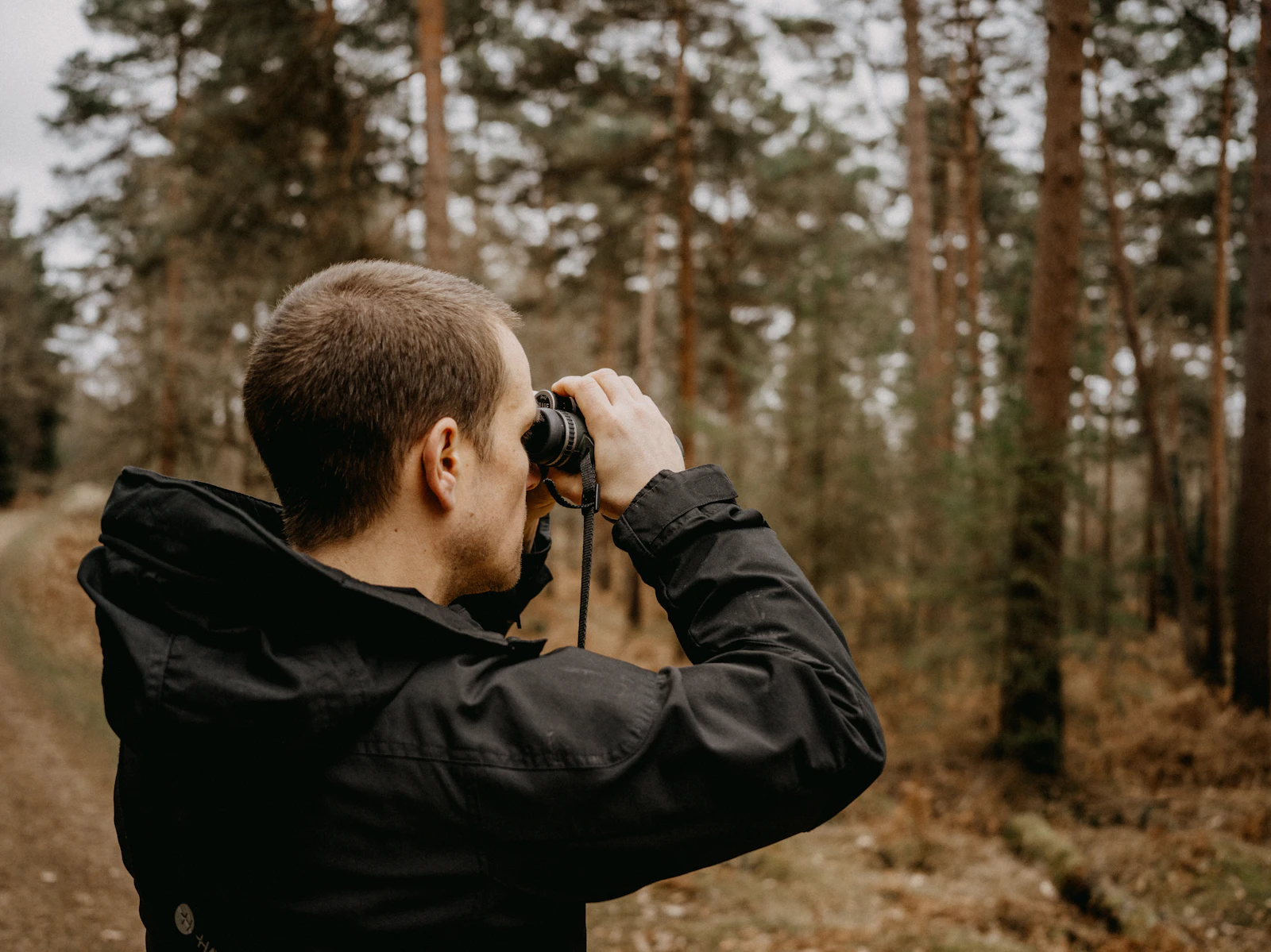
A bird lands across the pond and is gone before you have found it through a borrowed pair of binoculars. That moment is a helpful introduction to the purchase: getting a comfortable view quickly matters more than the largest number printed on the body. A familiar local park is a good place to learn what you enjoy looking at.
This is a beginner’s selection framework based on published product information, not an optical lab test or a claim of firsthand use.
Choose for your everyday.
Try different sizes in person and prioritize a clear, comfortable view that you can find without fuss. A moderate, manageable format is a sensible place to begin; borrow before buying when possible.
In this guide
Borrow a pair before drawing up a shortlist
A short walk with borrowed binoculars can tell you whether you enjoy the activity and what bothers you about the equipment. Note how they hang, how quickly you locate a subject and whether you keep putting them back in the bag. Those observations create a more useful brief than buying for a future expedition.
Choose an easy, lawful place to practice and observe wildlife respectfully from a distance. Equipment should help you watch without approaching or disturbing animals. If a local group offers a beginner walk, its members may also help explain adjustments without requiring an immediate purchase.
Understand the two numbers
In a format such as 8x30, the first number indicates magnification and the second describes the objective-lens diameter in millimeters. Those numbers identify a configuration, not a complete quality ranking. Other aspects of the optical design and your own fit still affect the experience.
More magnification also makes ordinary hand movement more apparent in the view. Rather than assuming higher is better, compare a moderate option with a higher-power one while looking at the same distant object. Check whether you can find it, hold it comfortably and refocus without frustration.
Fit the eyecups to your eyes
Adjust the spacing between the barrels until the view suits your eye position, then follow the instructions for the eyecups and focus system. If you wear glasses, try the binoculars with them on. Notice whether you can see the view comfortably without repeatedly shifting your face.
Nikon’s PROSTAFF P3 family includes several formats and adjustable eyecups, so it is a useful named family for comparison. The official pages describe the available versions. This guide does not claim that one will fit every face or that its optics have been tested against competing models.
Carry the pair for more than a minute
Lift the binoculars several times and hold them for an ordinary viewing pause. Check the grip, focus-wheel reach and where the strap sits. A pair that feels fine for a quick counter demonstration may become less appealing after repeated use, while a compact pair may be easier to take along spontaneously.
Balance portability with viewing comfort. Small size is useful only if you can use the binoculars comfortably. Check how the case fits in your regular bag and whether lens covers are convenient to manage rather than assuming the included accessories will suit your routine.
Avoid buying an entire hobby at once
Start with binoculars and a simple way to identify what you see. A specialist bag, tripod or collection of accessories can wait until you know the actual limitation. If a pair you can borrow already works well, spending time outside may improve your experience more than an immediate upgrade.
Before checkout, confirm the exact configuration, return terms and care instructions. Keep lenses protected and use the manufacturer’s cleaning guidance. Never use binoculars to look at the sun. For normal bird walks, your most useful upgrade may be a familiar route and a little patience.
A choice for each kind of day
Use the scenario as your starting point. The right option solves your own inconvenience without adding a new one.
| Your option | Makes sense for | The tradeoff |
|---|---|---|
| Moderate-power compact format | A pair you are willing to carry regularly | Small dimensions may affect handling and fit |
| Moderate-power full-size format | A comfortable grip and longer viewing pauses | Takes more space in a day bag |
| Borrowed binoculars | Learning your preferences before spending | Availability and adjustment may be less convenient |
Brands to put on your shortlist
These are starting points for your research, based on the brands’ published information. Check the exact version, dimensions, care instructions, delivery terms, and current price before ordering.
PROSTAFF P3 Binoculars
A binocular family for a local bird walk
- Multiple magnification and objective-size options
- Adjustable eyecups
Why consider it: Several formats to compare in the same product family
Keep in mind: Fit, steadiness and eye position need a personal trial
Explore at Nikon ↗Brand website · Not an affiliate link · Details checked Nov 12, 2026Your before-you-buy checklist
- Try with glasses if you wear them.
- Compare magnifications on the same subject.
- Check focus-wheel reach and strap comfort.
- Verify the exact model configuration.
Before you decide
Does higher magnification mean better binoculars?
No. It is one design choice. Your ability to locate and hold a subject comfortably matters, along with optical design and fit.
Should I buy a tripod immediately?
For ordinary beginner bird walks, first identify whether you actually need one and whether the exact binoculars support your intended setup.
Is this an optical performance review?
No. The guide explains selection criteria and links a real product family for further comparison without invented test results.
Sources & editorial notes
Brand information last checked Nov 12, 2026. Our scenario recommendations are editorial judgments, not laboratory results. Stock images illustrate everyday use and are not product verification.
See a detail that needs updating? Send a correction.